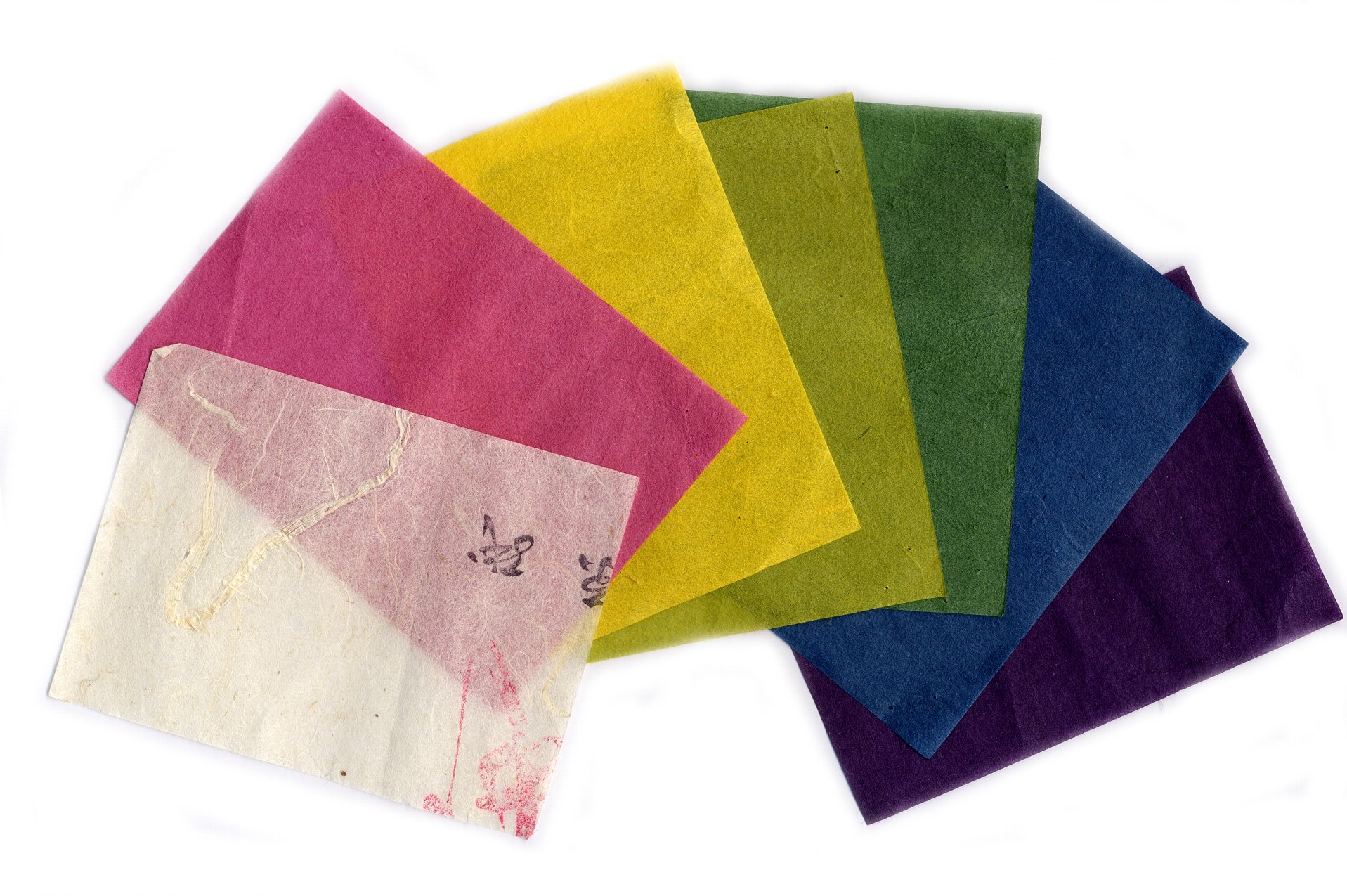
Kami: the standard practice paper
Kami is the thin, coloured square most people picture as "origami paper". It is light, usually coloured on one side and white on the other, and pre-cut into squares. It folds sharply and shows clean reference creases, which makes it ideal for learning a model and for thin multi-layer points like a crane's neck.
Its weakness is durability. Repeated folding along the same line will eventually weaken kami, and very thick models can split at a heavily layered point. For learning and for single-session models it is hard to beat.
Washi: fibre over flatness
Washi is a traditional Japanese paper made from long plant fibres. Those fibres make it strong and slightly textured, and they let it hold a gentle, rounded crease rather than a knife-sharp one. That suits wet-folding and decorative models more than precise geometric work.
Because washi takes a softer crease, it forgives a slightly mis-placed fold but resists the crisp, repeatable references that complex diagrams depend on. Many folders learn on kami and move to washi for display pieces.
Foil-backed paper
Foil-backed paper laminates a thin metal foil to a paper face. It holds a crease almost permanently and lets a finished model keep a shaped curve, which is why it appears in insects and other complex single-sheet work. The trade-off is that creases are hard to undo, so a mistake tends to stay visible.
Printer and copy paper
Ordinary printer stock, usually around 80 grams per square metre, is the most available paper of all and a perfectly good place to start. It is stiffer than kami, so very thin points are harder, but for bases, boxes and practice it works and costs almost nothing. Cutting a square from a standard sheet is itself a useful first exercise.
Quick comparison
| Paper | Relative weight | Crease | Best for |
|---|---|---|---|
| Kami | Light | Sharp | Learning, thin points |
| Washi | Light–medium | Soft | Wet-folding, display |
| Foil-backed | Light | Holds shape | Complex single-sheet |
| Printer | Medium | Stiff | Practice, boxes |
Grain, and why it matters
Machine-made paper has a grain — a direction in which the fibres mostly lie. Paper folds and tears more cleanly along the grain than across it. For symmetric models the grain direction is rarely critical, but when a fold resists or a square will not sit flat, rotating the sheet ninety degrees sometimes solves it.
Choosing paper in Canada
Specialist kami and washi are not always stocked in general stationery shops outside larger cities, so many folders order online or pick them up from Japanese stationery sections and art-supply stores. Good-quality printer paper is a reliable everywhere substitute when a specific paper is unavailable.
Heated indoor air in a Canadian winter is dry, which keeps creases crisp but can make paper a little brittle; a very short time in slightly more humid air before folding can help thicker stock cooperate.
Further reading: Origami paper (Wikipedia)